Ask a welding inspector where the standards live and you usually get one of three answers: a folder of PDFs on a laptop, a company login to ASTM Compass or Accuris (the old Techstreet), or "I'll check when I'm back at the office." We build Probe361, so we have a side in this. This page compares the three honestly for one specific job: an engineer on site who needs to find a clause fast, sometimes without signal, sometimes in Persian as well as English, and needs to know which edition they are reading. Facts about the other platforms come from their own pages, checked on 29 September 2026.
The short version
If your company needs broad coverage across many publishers, official licensed copies, redlines between editions and alerts when a standard changes, ASTM Compass or Accuris is the right tool and Probe361 is not a replacement. If the actual problem is an inspector on a site with bad connectivity who needs AWS D1.1 or an ASME piping clause on a phone, with a Persian rendering next to the English text, Probe361 was built for that and the big platforms were not. A PDF folder is free and works offline, and it fails exactly where the mid-project clause lookup problem starts: nobody is sure it is the current edition.
Side by side
| PDF folder | ASTM Compass | Accuris (Techstreet) | Probe361 | |
|---|---|---|---|---|
| Catalogue size | Whatever you bought | ASTM's 13,000+ standards, plus add-on content from API, AWS, AASHTO, AWWA and others | 500,000+ codes and standards from publishers worldwide | A small, focused set of welding and inspection standards |
| Official publisher licence | Yes, if purchased | Yes (ASTM is the publisher) | Yes, distributor agreements with publishers | No. Not an official distributor |
| Edition history and redlines | Manual | Historical, withdrawn and redline versions, colour-coded version comparison | Redlines, automatic updates, tracker alerts | Edition year and status shown on each standard; no redlines |
| Clause-level search | Ctrl+F in one file | Search, bookmarks, annotations | Search, highlights, section-level change alerts | Full-text search over a clause tree with figures and tables |
| Offline on a phone | Yes, if the file is on the device | Downloads are DRM-controlled | Mainly web-based | Installable PWA; standards you have opened stay available offline |
| Persian text | Only if someone translated it | No | No | Persian next to the original English, clause by clause |
| Pricing model | Per document | Institutional subscription, quoted | Per document or enterprise licence, quoted | From $9/month per person, $29/month for a team of 5, or an on-premise licence |
What the big platforms do better
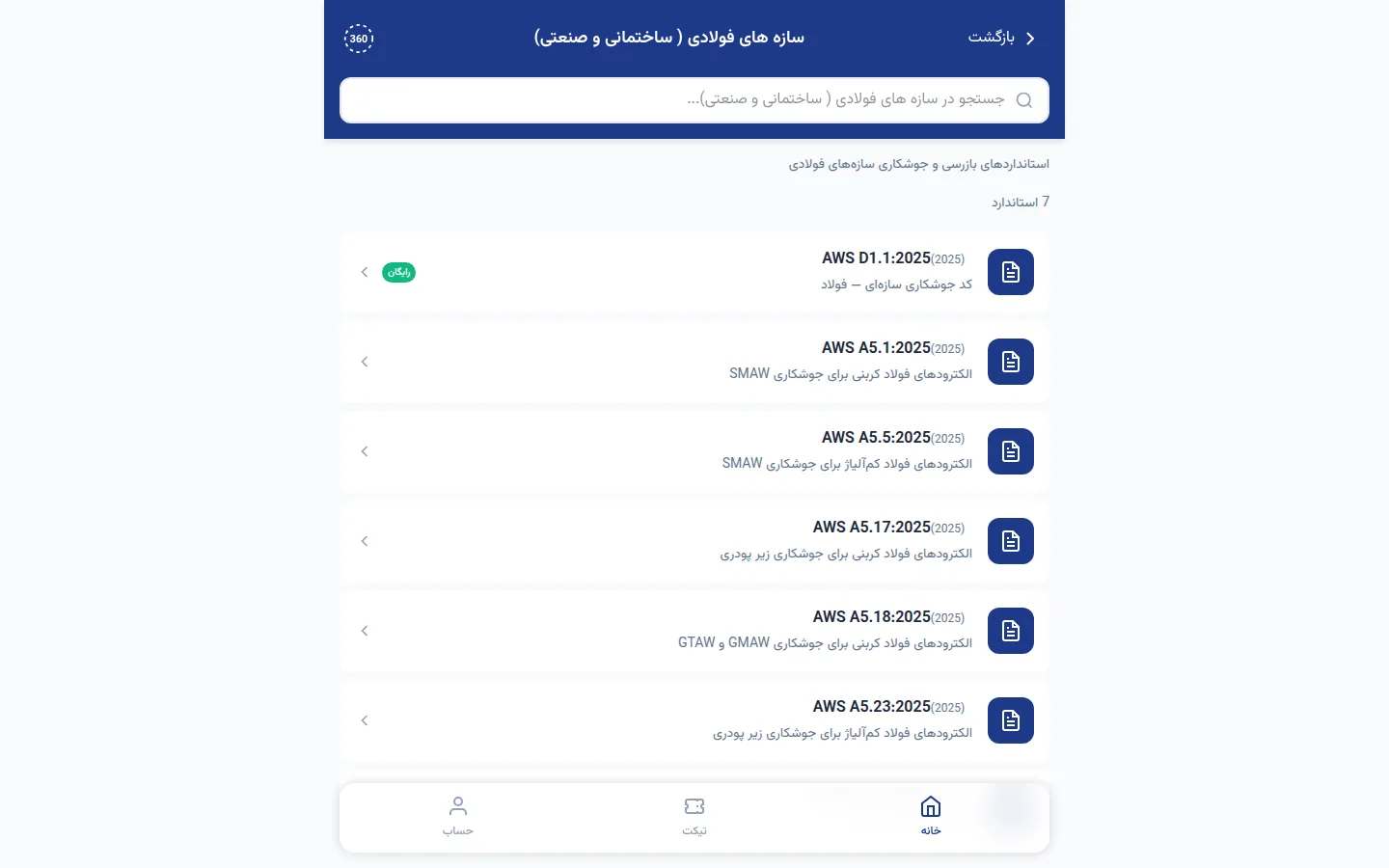
Breadth, mostly. Accuris says it carries more than 500,000 codes and standards, and ASTM Compass has ASTM's full catalogue plus content from API, AWS, AASHTO and several other bodies. Probe361 has a small fraction of that. Its library covers AWS, API and ASME, and right now the published set leans heavily on AWS D1.1, the AWS A5 filler-metal specifications and ASME B31.3. If your QA department needs 40 publishers in one contract, stop reading and call one of them.
Licensing is the second one, and it matters more than people admit. ASTM sells its own standards, and Accuris works under agreements with the publishers it distributes. When a client contract or an auditor says "a licensed copy of the current edition", that is what they mean. Probe361 is a reading and lookup tool, and it does not change what your contract requires you to hold.
Change tracking is the third. Compass gives you historical and withdrawn versions and redlines, where you pick two editions and see additions and deletions in colour. Accuris sells redlines too, and its alerts tell you when a passage you highlighted has changed. Probe361 shows the edition year and whether a standard is current, which answers "am I on the right edition", but it does not show you what changed between two editions.
Where the big platforms get awkward on site
They are built for a desk and an office network. Since late 2025, ASTM documents sold through the ANSI webstore have had to carry DRM with user-identifying watermarks, and ASTM's own licence says protected documents cannot be saved or stored as a permanent copy. That is a reasonable way for a publisher to protect its work. It also means the file on an inspector's phone is tied to a viewer app and a licence check, which is not what you want 30 metres up a tank shell with one bar of signal.
Language is the other gap. Neither platform offers Persian text. Most inspection crews in Persian-speaking countries handle that with a translation someone made once and shared in a chat group, and that translation drifts from the standard with every new edition.
The PDF folder, taken seriously
We don't want to dismiss it. A PDF you bought is licensed, works offline, and costs nothing extra. The trouble is everything around the file. Nothing in a folder tells you that the copy called D1.1-final.pdf is the 2020 edition and the project spec now references 2025. Search works inside one file, but not across the clause numbering of five different standards. And when a new edition comes out, like ISO 9001:2026 this year, the old file keeps sitting there looking just as official as the new one.
What Probe361 actually does
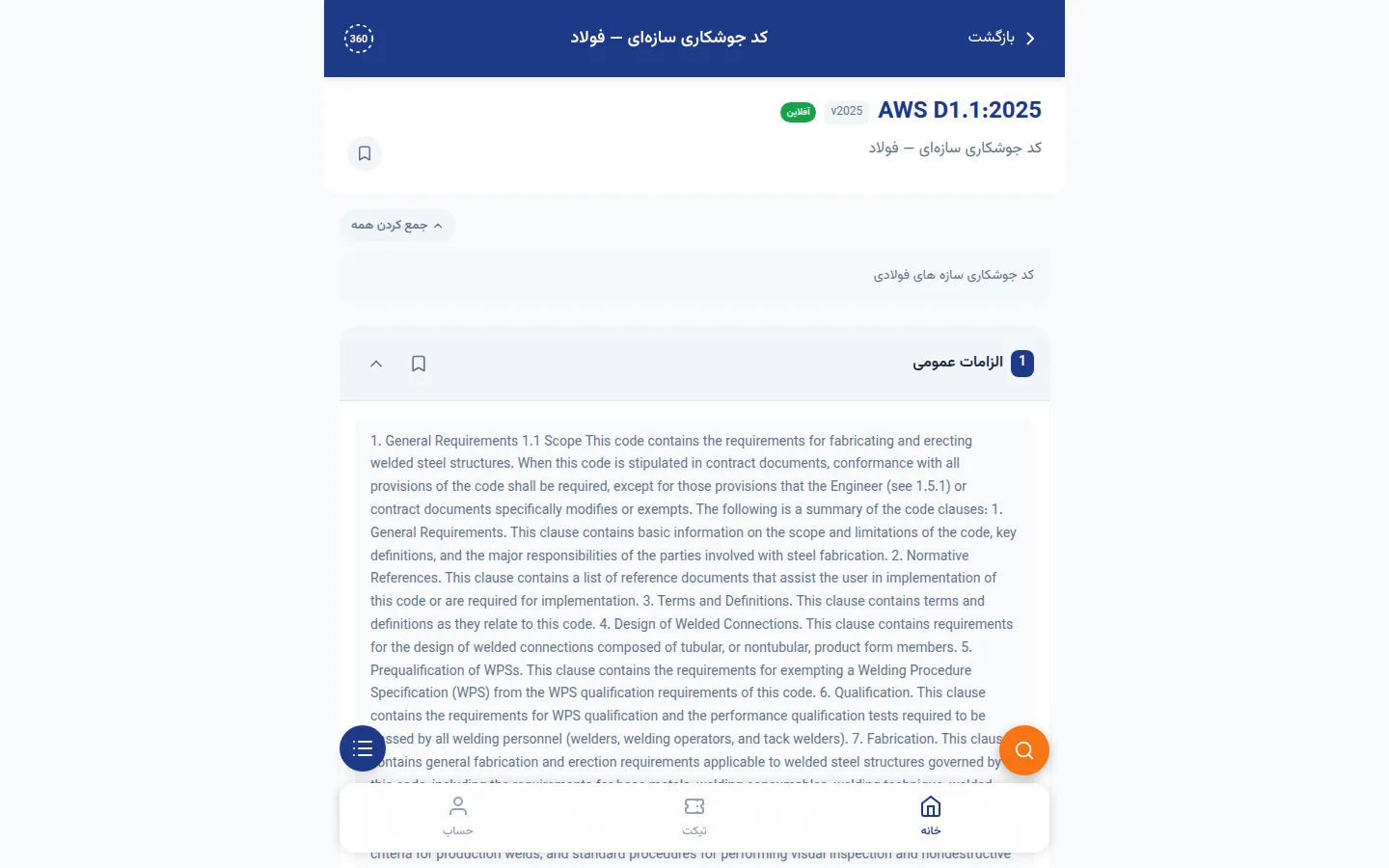
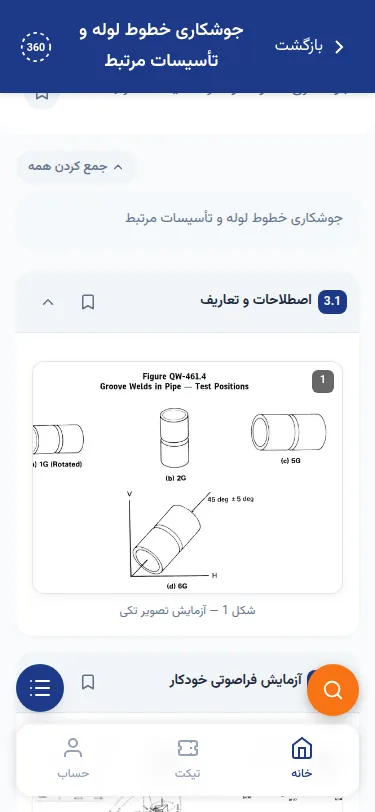
It is a Progressive Web App: you open it in a browser and install it to the home screen, no app store. Each standard is split into a clause tree, with figures and tables inline at full resolution. Search runs across clauses. Each standard shows its edition year, and older editions are marked as not current. Favourites are stored on the device, and the service worker caches what you've opened, so it stays readable when the network drops. The Persian text sits clause by clause next to the English, so an acceptance criterion in Persian points at the same clause number as the original. The interface itself is in Persian.
Pricing is on our pricing page: $9 a month for one person with the full library, $29 a month for up to 5 users, a quoted enterprise plan that can add company-specific standards, and a one-time on-premise licence for companies that want it on their own servers.
So which one?
For a corporate engineering library, where breadth, official copies and redlines matter, use ASTM Compass or Accuris. Keep the purchased PDFs of the standards your contracts cite, because that is your licensed record. For the person on site who needs the clause now, offline, and would rather read the acceptance criteria in Persian first, Probe361 sits next to those tools, not instead of them. A lot of teams will end up with two: the official library at the office, and something quick in the pocket.