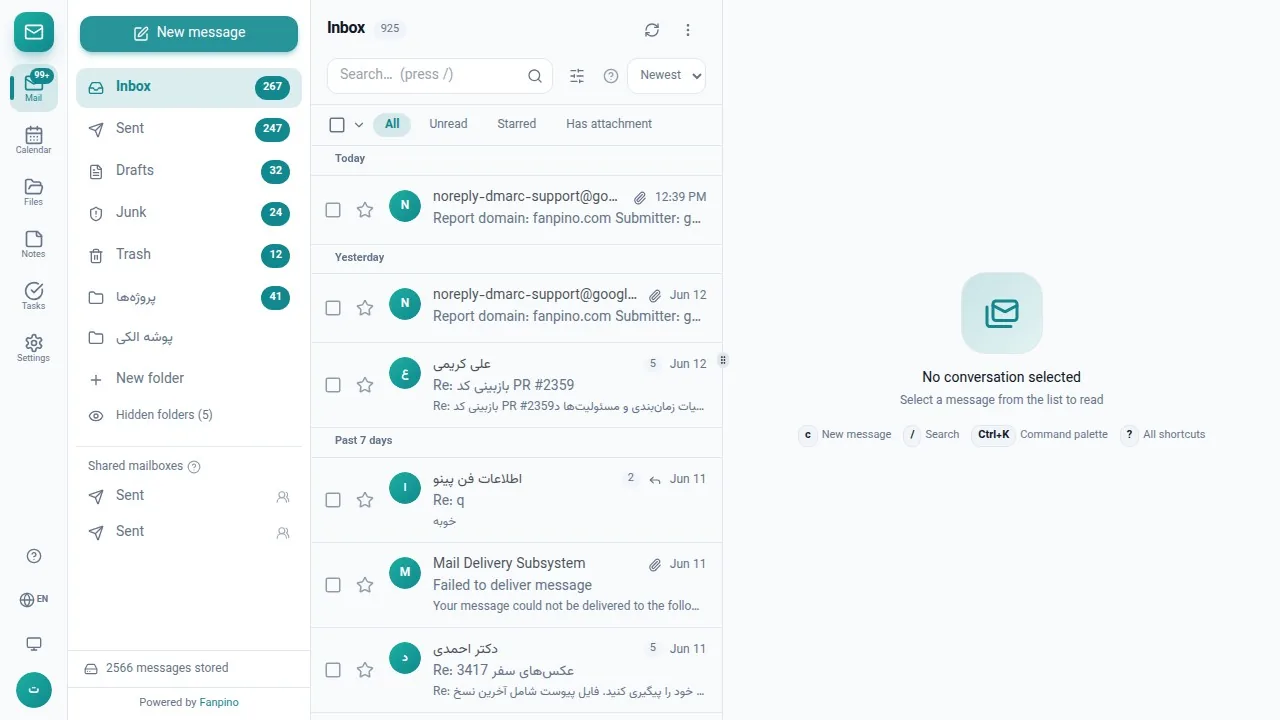
Most webmail still talks to the mail server over IMAP. IMAP was designed in 1986, and its current version, IMAP4rev2 (RFC 9051, August 2021), is still a stateful text protocol built for a desktop client that keeps a long-lived connection open. A browser tab is a different kind of client: it opens and closes, loses its network on a train, and wants a hundred things at once. JMAP, the JSON Meta Application Protocol, was written for that client. FanMail runs on the open-source Stalwart Mail Server, which speaks both protocols, and our webmail uses JMAP.
What is JMAP?
JMAP is an IETF standard for synchronising mail with a server using JSON over HTTPS. The core protocol is RFC 8620 (July 2019) and the mail data model is RFC 8621 (August 2019), both written by Neil Jenkins of Fastmail and Chris Newman of Oracle. A later document, RFC 8887 (August 2020), adds a WebSocket transport. RFC 8621 is designed so a server can expose the same mailbox over IMAP and JMAP at the same time.
IMAP and JMAP side by side
| IMAP (RFC 9051) | JMAP (RFC 8620/8621) | |
|---|---|---|
| Format | Line-based text commands over a persistent TCP connection | JSON over HTTPS, optional WebSocket (RFC 8887) |
| Many actions at once | Commands are pipelined, but each folder needs its own selected state | Several method calls in one request, and later calls can use the results of earlier ones |
| New mail | IDLE watches one selected folder per connection | Push for all changes on the account, then a fetch of only what changed |
| Reconnect after a dropped network | Client re-selects folders and compares state | Client sends its last state string and gets back the changes since then |
| Sending | Separate protocol (SMTP submission) | Submission is part of the same API |
| Best client | Desktop and phone mail apps | Web and mobile apps that come and go |
What that changes for the person reading email
- Bulk actions are one request. Moving or marking a hundred messages is one call with a list of IDs, not a loop of commands.
- Opening the inbox is one round trip. The client can ask for the message list and the headers of those messages in the same request, because the second call refers to the result of the first.
- A dropped connection costs little. After a train tunnel or a laptop lid, the client asks for changes since its last state instead of re-scanning folders.
- Drafts, threads and sending live in one model. The composer does not have to stitch IMAP flags and a separate SMTP session together.
Why this matters more once you are self-hosting
A large hosted provider can hide a chatty protocol behind caching layers and a lot of hardware. A self-hosted server runs on machines you pay for, so the protocol shows up directly in how the mailbox feels and in server load at a few thousand users. Fewer round trips means fewer requests for the same work. If you are sizing that hardware, the trade-offs between engines are in Stalwart vs mailcow vs Mailu at 10,000 mailboxes.
JMAP does not replace IMAP for everyone. Outlook, Thunderbird and phone mail apps still connect over IMAP, and FanMail keeps IMAP on for them, so moving to it does not force anyone to change their mail client.
Proven at real scale
FanMail runs in production at 10,000-mailbox scale as a full replacement for IceWarp, with the built-in admin panel handling day-to-day server management. The cost side of that move is in our self-hosted email cost case study, and if you are still choosing between hosted and self-hosted, see FanMail vs Google Workspace vs Zoho Mail. Fast webmail still needs a login people will actually use, which is why FanMail also offers SMS one-time codes alongside authenticator apps. Product details are on the FanMail page.
Frequently asked questions
What is the difference between JMAP and IMAP?
IMAP is a stateful text protocol from 1986, now IMAP4rev2 (RFC 9051), built for desktop clients that keep a connection open. JMAP (RFC 8620 and RFC 8621, 2019) uses JSON over HTTPS, batches many actions into one request, pushes changes for the whole account and lets a client resync from its last state after a dropped connection.
Does JMAP replace IMAP?
Not for every client. RFC 8621 is designed so one server can offer the same mailbox over both protocols. Webmail and mobile apps benefit most from JMAP, while Outlook, Thunderbird and phone mail apps still connect over IMAP. FanMail keeps IMAP on, so users can keep their existing mail clients.
Which mail servers support JMAP?
Stalwart Mail Server, the open-source server FanMail runs on, supports JMAP for mail alongside IMAP, POP3 and SMTP, and lists the RFCs it implements in its documentation. Fastmail, whose engineers co-wrote the JMAP specifications, also uses it. Many other self-hosted stacks still offer IMAP only.
Is JMAP faster than IMAP?
For web clients it usually needs fewer round trips. One JMAP request can fetch the message list and those messages' headers together, a hundred messages can be moved in one call, and a reconnecting client asks only for changes since its last state. How fast it feels still depends on the server, the network and the client.