Most CBAM coverage in the Gulf has been about steel. Aluminium sits in the same annex of the regulation, though, and its quirks cut both ways: some help the exporter, some make the paperwork harder than steel. This piece is for extruders, smelters and fabricators in Saudi Arabia and the UAE who ship into the EU and keep getting data requests from buyers. Every rule below was checked against the regulation text or the European Commission's own pages on 13 October 2026.
Steel fabricators should read our CBAM guide for Gulf steel fabricators instead.
Which aluminium goods are in scope
Annex I of Regulation (EU) 2023/956 lists the aluminium CN codes: unwrought aluminium (7601), powders (7603), bars, rods and profiles (7604), wire (7605), sheet over 0.2 mm (7606), foil (7607), tubes and fittings (7608, 7609), structures and parts such as doors and window frames (7610), containers (7611 to 7613), stranded wire (7614) and other articles of aluminium (7616). Scrap (7602) is not on the list, and neither is 7615, the household and sanitary articles heading.
The greenhouse gases listed for every aluminium row are carbon dioxide and perfluorocarbons. PFCs come from anode effects in the electrolysis cell, so smelters monitor them separately.
The good news: no indirect emissions for aluminium, for now
Annex II of the same regulation is titled "List of goods for which only direct emissions are to be taken into account", and aluminium is on it, next to iron and steel and hydrogen. So the electricity your smelter or press used does not count toward what your EU buyer pays for in the definitive period.
This surprises people who lived through the transitional phase, when the Commission's factsheet for non-EU aluminium producers asked for indirect emissions in quarterly reports. Keep measuring your electricity data anyway. The recitals explain why it is left out: indirect emissions are not taken into account initially for goods whose EU producers receive compensation for electricity costs. The word to watch there is "initially".
Your input metal carries most of the number
For an extruder, pressing emits little next to what is already in the billet. The 2025 simplification, Regulation (EU) 2025/2083, says this directly in recital 16: for some aluminium and steel goods the embedded emissions are "primarily determined by the embedded emissions of input materials (precursors)", and finishing steps done by separate installations outside the EU ETS are taken out of the system boundaries.
So the hard question is "which billet lot went into this order, who cast it, and do I have that caster's emission figure". If you buy billet from more than one source, a single plant average will not survive verification.
The dates and thresholds your buyer is working to
- 50 tonnes a year. Since the simplification, an EU importer only needs to become an authorised CBAM declarant if it brings in more than 50 tonnes a year of CBAM goods, counted across steel, aluminium, cement and fertilisers together (Commission, definitive regime). Some smaller customers may drop out of CBAM entirely.
- 30 September 2027. The first annual CBAM declaration, covering imports made in 2026, is due by that date, and certificates are surrendered by the same date (2025/2083, amended Articles 6 and 22).
- 1 February 2027. Member States start selling certificates on the common central platform.
- Price. For 2026 imports the certificate price is set per quarter. The Commission published EUR 75.36 for Q1, EUR 75.28 for Q2 and EUR 82.32 for Q3 2026.
- 50% held each quarter. From 2027 a declarant must hold certificates covering at least half of the embedded emissions imported so far that year.
Default values or your own verified data
Your buyer has two routes. Default values, published by the Commission, are set at the average emission intensity of the exporting country plus a mark-up (Annex IV, point 4.1). Actual values come from your installation, and only actual values need checking by an accredited verifier (2025/2083, recital 19). The mark-up exists to give a clean plant a reason to send real numbers. If you run below the country average, defaults overstate your goods, and your customer will bring that gap to the next price negotiation.
The Commission also lets non-EU operators register installations in the operator portal of the CBAM Registry and share emission data with importers from there and report once instead of filling a spreadsheet per buyer (same factsheet).
What to set up in the plant
Most of the work is traceability, not chemistry. Tag each order with its CN code at quotation time, because 7604 profiles and 7610 window frames are different lines on your buyer's declaration. Record which billet lot went into each batch, with the supplier's emission statement beside it. Smelters need PFC monitoring per potline. Then talk to an accredited verifier before your buyer's first declaration is due, not after.
Fabricators who already trace heat numbers for steel, as in our digital product passport guide, will recognise the problem. It is the same chain of custody with a different metal.
Where SteelFlow MES fits
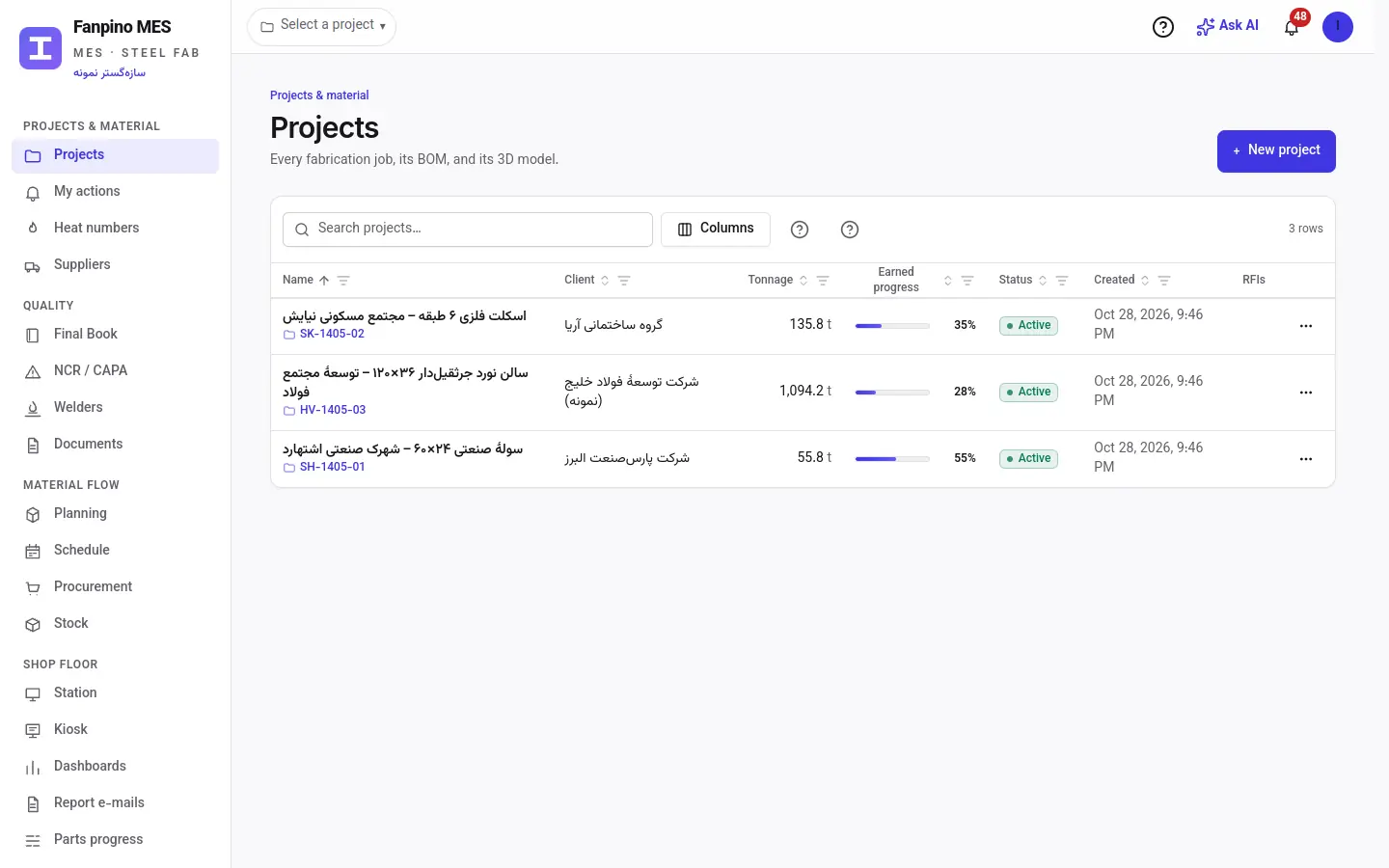
SteelFlow MES records which material lot went into which part at each station, offline if the network drops, and keeps that link in an audit trail. That covers the "which billet went where" half. It does not calculate embedded emissions or file anything in the CBAM Registry; that stays with your verifier and your buyer. More on lot-to-part tracing in our piece on manufacturing traceability.
Frequently asked questions
Do aluminium doors and window frames fall under CBAM?
Yes. CN 7610 covers aluminium structures and parts of structures, and the regulation names doors, windows and their frames as examples. Prefabricated buildings of heading 9406 are excluded.
Does the electricity my smelter uses count?
Not in the current definitive period. Aluminium is listed in Annex II of Regulation (EU) 2023/956, which means only direct emissions are counted. Keep the data: the recitals say indirect emissions are excluded only initially.
My EU customer imports only 30 tonnes a year. Does it need my emission data?
Probably not. Importers whose total CBAM goods stay at or below 50 tonnes a year, across steel, aluminium, cement and fertilisers combined, are exempt under the single mass-based threshold. The threshold counts all of its CBAM imports, not only yours.
Who pays for the CBAM certificates, the exporter or the importer?
The authorised CBAM declarant in the EU buys and surrenders the certificates. The cost still shows up in price talks.
Sources: Regulations (EU) 2023/956 and 2025/2083; European Commission CBAM pages, 13 October 2026. Not legal advice.