ISO 3834 audits rarely get hard because of weld quality. They get hard because the records that prove weld quality are spread across five places: welder certificates in the coordinator's drawer, plate certificates in the store, NDT reports in a subcontractor's email, and NCRs in a spreadsheet only one person can open. This checklist is for finding the gaps a week before the audit, not the night before.
What ISO 3834 actually assesses
ISO 3834 sets quality requirements for fusion welding of metallic materials. It treats welding as a "special process", meaning you can't fully verify the result after the fact, so the auditor looks for evidence of control during the work instead of only checking the finished product. The current edition of Part 2 (comprehensive requirements) is ISO 3834-2:2021, and product standards such as EN 1090 (execution of steel structures) and EN 15085 (welding of railway vehicles) refer to it. If you fabricate for export projects or European clients, you have probably already seen it in a contract.
TWI Certification makes an important point in its own training presentation on ISO 3834. The standard itself only mandates formal documentation for document control and for contract and product records. The EWF rules and the EA-6/02 guidance that certification bodies follow are stricter, and expect written procedures for contract review, welding consumables, parent material storage, non-conformance and product traceability. In practice, that means you need to be able to show the records in the table below.
The records checklist, clause by clause
The first column uses the names of the technical elements of ISO 3834-2 as TWI lists them. Fill in the third column for your own shop. Any row you can't answer clearly is the first gap the auditor will find.
| Element | Record the auditor wants to see | Who usually holds it |
|---|---|---|
| Review of requirements | Minutes or a review form: project standard, execution class, NDT requirements, document deliverables | Sales / engineering |
| Technical review | Approved drawings with revision numbers, a joint list and the WPS needed for each joint | Welding coordinator |
| Subcontracting | List of outsourced work (cutting, galvanizing, NDT) and the qualification evidence for each subcontractor | Purchasing / quality |
| Welders and operators | A valid qualification certificate for each welder (for example to ISO 9606-1) with revalidation date and range of qualification | Welding coordinator |
| Welding coordination | Name, tasks and written authority of the coordinator per ISO 14731 | Management |
| Inspection and testing personnel | Qualification evidence for visual inspectors and NDT operators | Quality |
| Equipment | List of welding and preheat equipment, maintenance records, calibration of ammeters and voltmeters | Maintenance |
| WPS and WPQR | A WPS for each joint and the procedure qualification record (WPQR) behind it | Welding coordinator |
| Welding consumables | Batch certificates for electrodes and wire, drying oven and electrode store records | Store / quality |
| Parent material | Mill test certificates (MTC) and transfer of the heat number to each part after cutting | Store / cutting |
| Heat treatment | Charts or records of preheat and PWHT where required | Production |
| Inspection and testing | Visual and NDT report for each weld, with part number and inspector name | Quality |
| Inspection status | A tag or recorded accept / reject / pending status on every part | Quality |
| Non-conformance | NCR with cause, corrective action and close-out sign-off | Quality |
| Identification and traceability | The link part, weld, welder, WPS, heat number | Everyone |
Three places most shops get stuck
- Heat number transfer after cutting. The plate certificate is in the store, but once the plate is cut and the parts are labelled, nobody can say which part came from which plate. If the part mark isn't recorded on the cutting sheet, traceability breaks right there. We walk through that path from cutting to dispatch in our piece on barcode tracking of part marks.
- Expired welder certificates. Certificates have revalidation dates, and a welder may have worked outside their range of qualification (process, thickness, position). Auditors often pick a few welds at random and ask who made them and whether that welder's certificate was valid on that day.
- NCRs that never close. The non-conformance is logged and the corrective action is written down, but there is no evidence the action was carried out and verified.
A ten-minute test before the audit
Pick three delivered parts from three different projects at random. For each one, without asking anyone for help, find five things: the drawing at the right revision, the WPS for each weld, the welder's name and certificate, the visual and NDT reports, and the plate certificate with its heat number. If any part takes more than ten minutes, the auditor won't wait that long either. Our free shop-floor records check asks the same questions step by step and shows the result on the spot.
When records are tied to the part from the start
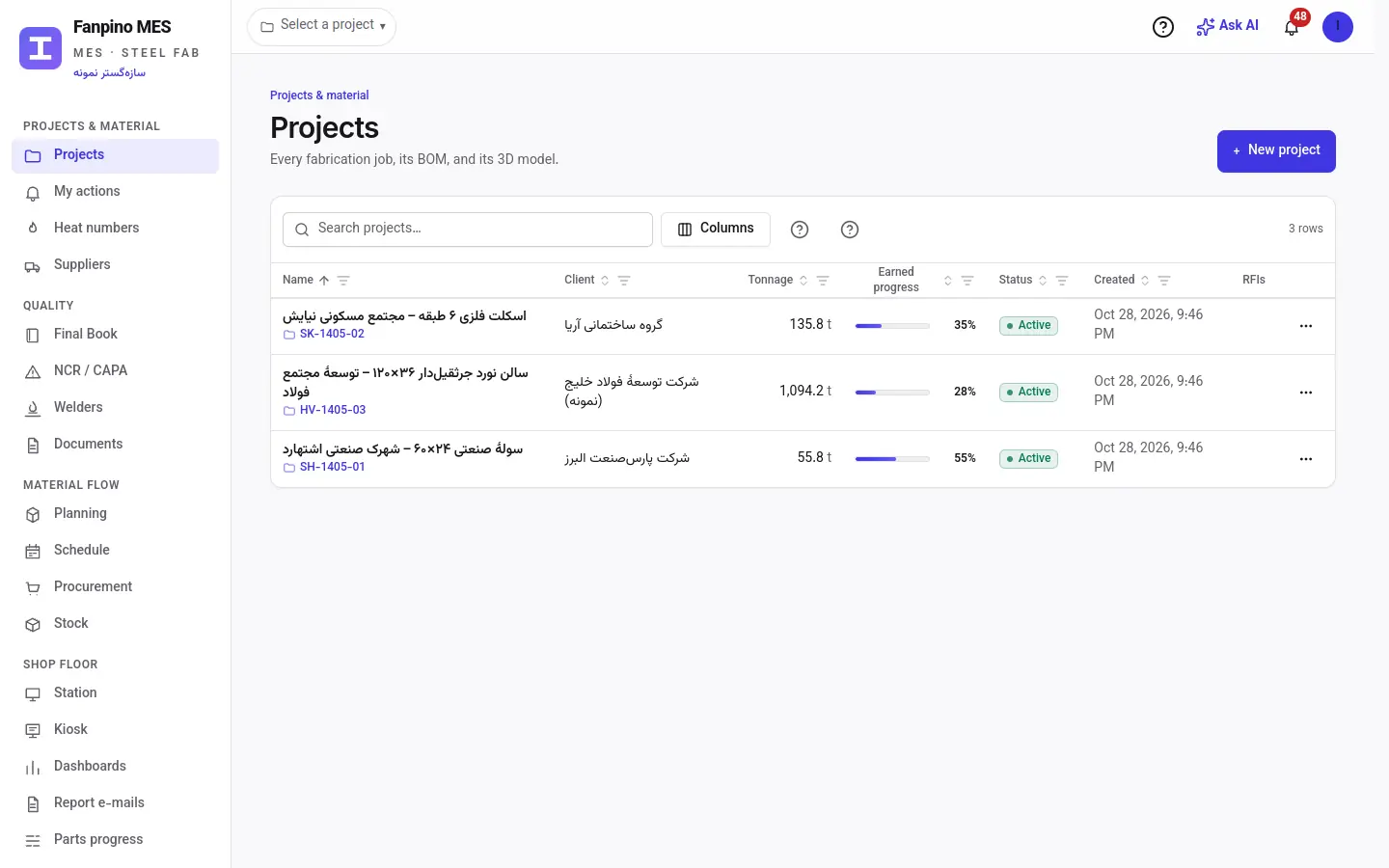
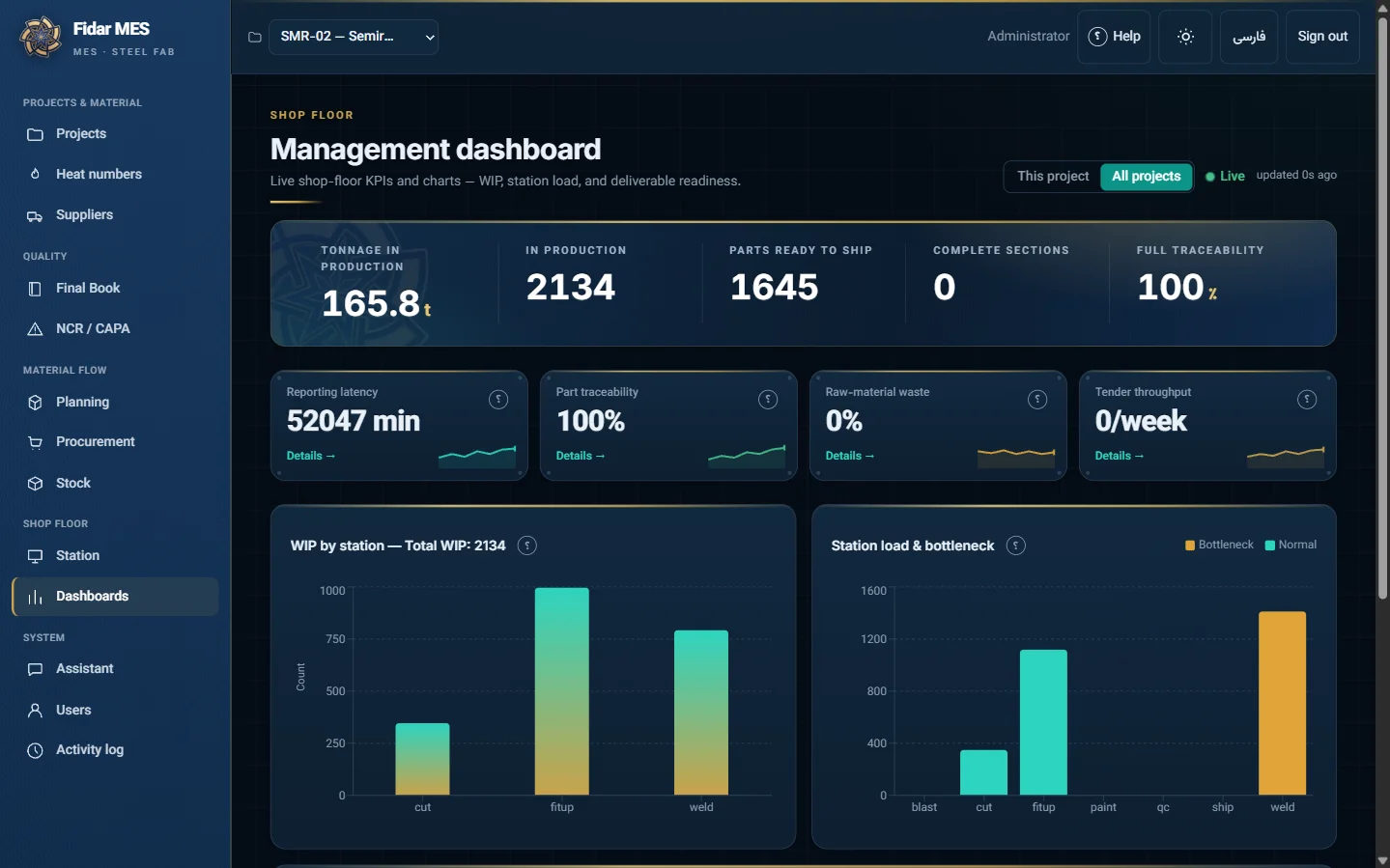
The easier way is to attach records to the part at the moment the work is done, not in delivery week. In SteelFlow MES, the WPS and WPQ qualification check, NDT results and coating inspection are linked to each part, non-conformances go through an NCR/CAPA workflow, and the manufacturing record book (MRB) is generated as a PDF straight from that record. We describe the details in this article. None of this replaces physical inspection or a welder's skill. It closes the gap between the work that was done and the paper that proves it.
Frequently asked questions
Is ISO 3834 the same as ISO 9001?
No. ISO 3834 covers quality requirements specific to fusion welding, and according to TWI Certification it does not require a full quality management system. Many shops hold both, but an ISO 3834 audit focuses on the welding process itself and its records.
Which part of ISO 3834 matters for a structural steel shop?
The contract or the product standard sets the level. Part 2 (comprehensive requirements) is the strictest level, and this checklist follows its elements. Parts 3 and 4 are lighter levels.
Why does tracing a weld back to the heat number matter so much?
When a weld fails NDT, the first question from the auditor or the client is who welded it, with which WPS, and on which plate. If that chain wasn't recorded at the time, rebuilding it from paper and spreadsheets takes hours.
Does this checklist replace a consultant or a certification body?
No. The full text of the standard has to be bought from the publisher, and the final interpretation belongs to the certification body. This list helps you see, before the audit, which records are scattered or missing.
Sources: TWI Certification, ISO 3834 why is it important to you (2015); ISO 3834-2:2021 listing. The full standard is available from the publisher, and this checklist does not replace it.